
Scale vCluster workloads from central KEDA
Configure Kedify Agent once to discover vClusters hosted in the central cluster automatically. Run KEDA alongside it, and use a separate DistributedScaledObject (DSO) for each workload in each member vCluster. Each DSO explicitly selects one member cluster.
This walkthrough uses two shared-node vClusters hosted in the central cluster. The application Deployments belong to the vClusters. Their pods run on shared host nodes through vCluster’s normal synchronization.
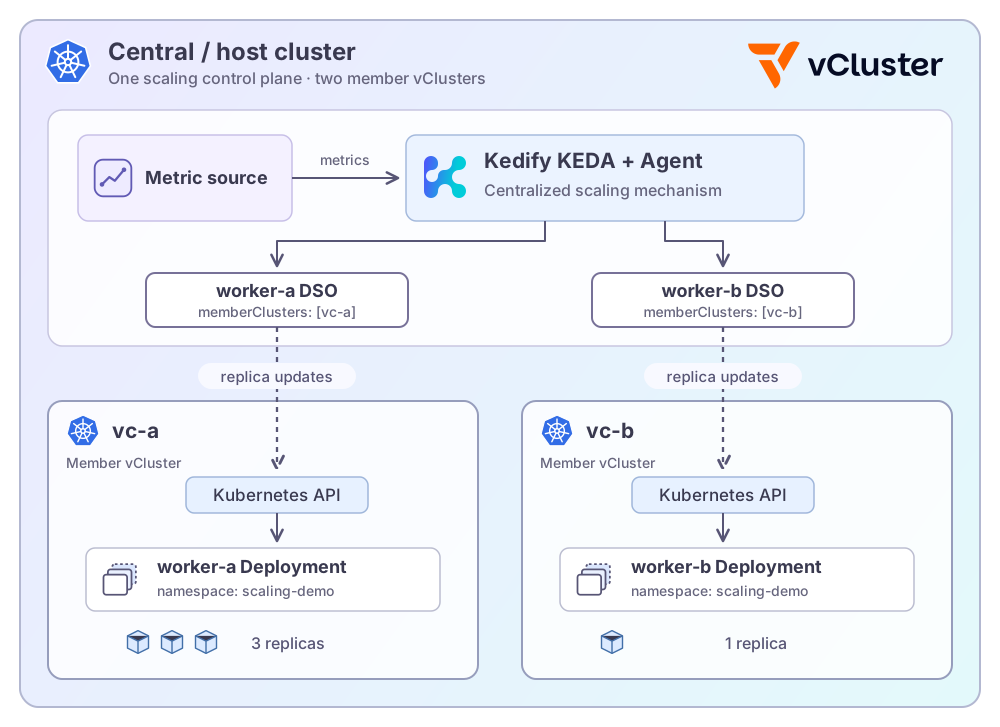
There are no application Deployment targets in the central Kubernetes API. KEDA’s generated ScaledObjects and HPAs stay central and target the DSOs. The central cluster also holds a ConfigMap with one metric value per workload for this exercise.
Prerequisites
Section titled “Prerequisites”- A central cluster with Kedify KEDA and Kedify Agent installed in
keda. The Agent image and chart must support automatic vCluster discovery; Agentv0.7.0does not include this feature. kubectl, Helm,jq, and the vCluster CLI0.36.0.- A default StorageClass that can provision persistent volumes for the vCluster control planes.
The manifests below pin vCluster OSS 0.36.0 and virtual Kubernetes 1.34.3. Review vCluster’s shared-node prerequisites for your host cluster.
1. Enable automatic discovery
Section titled “1. Enable automatic discovery”Merge these values into your central Agent’s existing Helm configuration and apply your usual Helm or GitOps upgrade:
global: features: multicluster: enabled: true vClusterDiscoveryEnabled: trueThis is a one-time setup. The chart grants the Agent get, list, and watch access to host Secrets and Services. Discovery reads credentials directly from the vCluster namespaces and keeps connections in memory. The Agent discovers both existing vClusters and new ones as they appear, using vCluster’s native Secrets and labels.
2. Create the member vClusters
Section titled “2. Create the member vClusters”Save as vcluster.yaml:
controlPlane: distro: k8s: enabled: true image: tag: v1.34.3 statefulSet: image: repository: loft-sh/vcluster-oss resources: requests: cpu: 100m memory: 256Mi limits: memory: 768Mi persistence: volumeClaim: enabled: truetelemetry: enabled: falseThe control planes use persistent volumes from the host cluster’s default StorageClass. If your cluster has no default, set controlPlane.statefulSet.persistence.volumeClaim.storageClass to an available StorageClass name.
Choose either installation method. Both install the same vCluster Helm chart and produce the native Service and kubeconfig Secret used by automatic discovery.
for member in a b; do helm upgrade --install "vc-$member" vcluster \ --repo https://charts.loft.sh --version 0.36.0 \ --namespace "vcluster-$member" --create-namespace \ --values vcluster.yaml \ --wait --timeout 5mdonefor member in a b; do vcluster create "vc-$member" \ --driver helm \ --namespace "vcluster-$member" \ --chart-version 0.36.0 \ --values vcluster.yaml \ --connect=falsedoneThe Agent reads each vCluster’s default kubeconfig export and connects through its internal Service with TLS verification enabled. It leaves the native export unchanged, so vcluster connect continues to work.
3. Verify automatic discovery
Section titled “3. Verify automatic discovery”Check member status in the central cluster:
kubectl -n keda get kedifyconfiguration -o json | jq -r '["MEMBER", "PROVIDER", "STATE"], (.items[].status.multiClusterStatus.clusters // {} | to_entries[] | [.key, .value.provider, .value.state]) | @tsv'Repeat the status command until both vc-a.vcluster-a and vc-b.vcluster-b report Connected through the vcluster provider before continuing. Each alias combines the vCluster name and its host namespace, keeping identically named vClusters in different namespaces distinct.
The Agent reuses vCluster’s default tenant-admin credentials. It manages registration, credential updates when vCluster rotates its export, and removal when a vCluster is deleted.
For dedicated credentials with narrower permissions instead of the exported tenant-admin identity, see the GitOps setup guide.
4. Deploy one workload per vCluster
Section titled “4. Deploy one workload per vCluster”Use the vCluster CLI’s command mode for tenant operations. It handles the temporary connection and kubeconfig for each command without changing your current central context:
for member in a b; do vcluster connect "vc-$member" -n "vcluster-$member" -- kubectl create namespace scaling-demo vcluster connect "vc-$member" -n "vcluster-$member" -- kubectl apply -f - <<EOF_WORKERapiVersion: apps/v1kind: Deploymentmetadata: name: worker-$member namespace: scaling-demospec: replicas: 0 selector: matchLabels: app: worker-$member template: metadata: labels: app: worker-$member spec: containers: - name: worker image: registry.k8s.io/pause:3.10 resources: requests: cpu: 1m memory: 4Mi limits: memory: 16MiEOF_WORKERdoneThese pods only demonstrate replica changes. Replace them with your workers for a real metric source.
5. Create DistributedScaledObject
Section titled “5. Create DistributedScaledObject”Most KEDA scalers can provide metrics for a DSO, including queues, Prometheus, and cloud event sources. Configure the metric endpoint and authentication for access from central KEDA. CPU and memory triggers require pod metrics from the cluster running the workload, so they cannot measure these tenant pods through the central DSO. The HTTP add-on also needs separate traffic-routing integration and is outside this walkthrough.
For a self-contained example, use Kedify’s kubernetes-resource scaler to read one ConfigMap value per workload.
Save as metrics.yaml and apply it to the central cluster:
apiVersion: v1kind: Namespacemetadata: name: scaling-demo---apiVersion: v1kind: ConfigMapmetadata: name: demo-metrics namespace: scaling-demodata: a: "0" b: "0"kubectl apply -f metrics.yaml
for member in a b; do kubectl apply -f - <<EOF_DSOapiVersion: keda.kedify.io/v1alpha1kind: DistributedScaledObjectmetadata: name: worker-$member namespace: scaling-demospec: memberClusters: - name: vc-$member.vcluster-$member scaledObjectSpec: scaleTargetRef: kind: Deployment name: worker-$member minReplicaCount: 0 maxReplicaCount: 5 pollingInterval: 5 cooldownPeriod: 15 advanced: horizontalPodAutoscalerConfig: behavior: scaleDown: stabilizationWindowSeconds: 0 triggers: - type: kubernetes-resource metadata: resourceKind: ConfigMap resourceName: demo-metrics key: $member targetValue: "1"EOF_DSOdoneSelecting memberClusters restricts scaling to a subset of registered tenant clusters. Omitting the list selects all registered members and distributes the workload according to the configured strategy. Repeat this single-member pattern for additional workloads. By default, each target Deployment must exist in the same namespace as its DSO.
6. Verify independent scaling
Section titled “6. Verify independent scaling”Set different metric values:
kubectl -n scaling-demo patch configmap demo-metrics \ --type merge -p '{"data":{"a":"3","b":"1"}}'Wait for A to reach three available replicas and B to reach one:
vcluster connect vc-a -n vcluster-a -- kubectl -n scaling-demo wait deployment/worker-a \ --for=jsonpath='{.status.availableReplicas}'=3 --timeout=180svcluster connect vc-b -n vcluster-b -- kubectl -n scaling-demo wait deployment/worker-b \ --for=jsonpath='{.status.availableReplicas}'=1 --timeout=180sThen bring A to zero while increasing B:
kubectl -n scaling-demo patch configmap demo-metrics \  --type merge -p '{"data":{"a":"0","b":"2"}}'
vcluster connect vc-a -n vcluster-a -- kubectl -n scaling-demo wait deployment/worker-a \  --for=jsonpath='{.spec.replicas}'=0 --timeout=180svcluster connect vc-b -n vcluster-b -- kubectl -n scaling-demo wait deployment/worker-b \  --for=jsonpath='{.status.availableReplicas}'=2 --timeout=180svcluster connect vc-a -n vcluster-a -- kubectl -n scaling-demo get podskubectl -n scaling-demo get dso,scaledobject,hpa
Allow for polling, HPA reconciliation, pod startup, and termination. A’s pods should disappear while B remains scaled. The short cooldown and stabilization settings are for this exercise; choose suitable values for real workloads.
Finally, return both workloads to zero:
kubectl -n scaling-demo patch configmap demo-metrics \ --type merge -p '{"data":{"a":"0","b":"0"}}'for member in a b; do vcluster connect "vc-$member" -n "vcluster-$member" -- kubectl -n scaling-demo wait "deployment/worker-$member" \ --for=jsonpath='{.spec.replicas}'=0 --timeout=180s vcluster connect "vc-$member" -n "vcluster-$member" -- kubectl -n scaling-demo wait pod \ -l "app=worker-$member" --for=delete --timeout=120sdoneVerify that each member has only its own application Deployment and no KEDA installation:
vcluster connect vc-a -n vcluster-a -- kubectl get deployments -Avcluster connect vc-b -n vcluster-b -- kubectl get deployments -Avcluster connect vc-a -n vcluster-a -- kubectl get crdsvcluster connect vc-b -n vcluster-b -- kubectl get crdsTroubleshooting and scope
Section titled “Troubleshooting and scope”- Member does not appear: check that the Agent image and chart support discovery, both feature values from step 1 are enabled, and the chart’s RBAC is installed. This integration expects the standard shared-node Helm export
vc-<name>and Service<name>in the vCluster’s host namespace, with their native vCluster labels. Custom export names and externally hosted or private-node vClusters are outside this walkthrough. - Member does not connect: check the API endpoint from the Agent pod’s network, TLS SANs, the CA, and the permissions of the exported credentials. A successful
vcluster connectcommand does not establish Agent connectivity. - DSO reports a missing Deployment: inspect
status.memberClusterStatusesand check the target name and namespace in the member API. Do not target the host’s synchronized pod names. - Metrics fail: check that the central
scaling-demo/demo-metricsConfigMap exists and itsaandbvalues are numeric. Thekubernetes-resourcescaler requires Kedify KEDA. For other metric sources, ensure the endpoint and authentication work from central KEDA. - Member API is unavailable: its workloads cannot receive replica updates. A DSO pinned to that member has no other scaling destination. Check per-member status before relying on the aggregate replica count.
- Jobs: similar configuration is available for
DistributedScaledJob. The global multi-cluster switch enables Kedify KEDA’s required raw metrics service; see the DSJ guide.
Shared-node vClusters share host capacity and infrastructure failures. This walkthrough demonstrates scaling integration. For hard tenant isolation and production control-plane availability, see vCluster tenancy models.
Cleanup
Section titled “Cleanup”Use these commands only for the disposable resources created by this walkthrough:
kubectl delete -f metrics.yamlfor member in a b; do helm uninstall "vc-$member" -n "vcluster-$member" kubectl delete namespace "vcluster-$member"doneDeleting the disposable central scaling-demo namespace removes its DSOs, generated scaling resources, and metric ConfigMap. Deleting the host vCluster namespaces also deletes their persistent volume claims. The Agent removes the discovered members automatically.