
How HTTP scaling works
This document explains how HTTP traffic metrics are collected, aggregated, and used for scaling decisions in Kedify.
Overview
Section titled “Overview”Kedify uses a distributed metrics collection system where:
- kedify-proxy (Envoy) handles traffic and collects metrics
- Interceptor aggregates metrics and pushes them to the scaler via gRPC bridge
- Scaler receives metrics and reports to KEDA
- KEDA makes scaling decisions based on metrics
Architecture Diagram
Section titled “Architecture Diagram”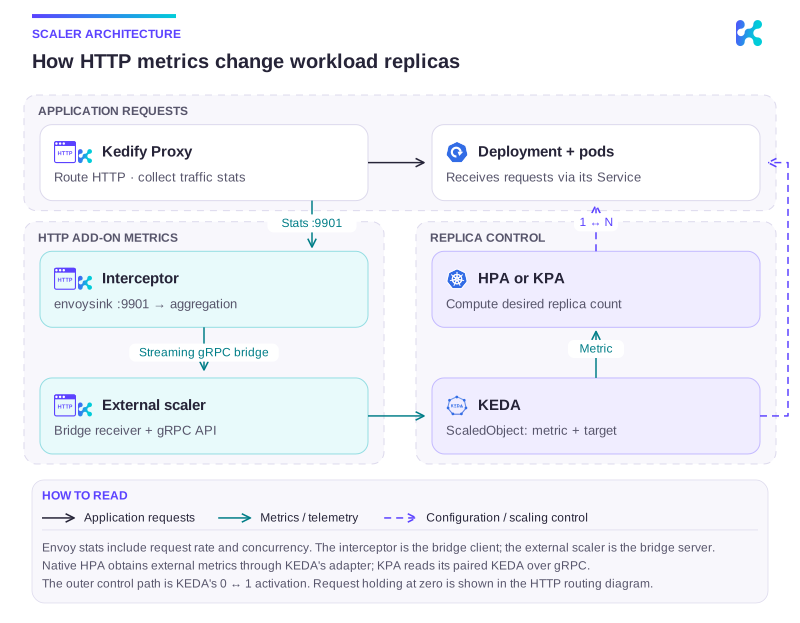
Diagram description
Kedify Proxy sends Envoy stats over gRPC to the interceptor's envoysink on port 9901. The interceptor aggregates them and streams batches through the gRPC bridge to the external scaler. KEDA reads the external scaler and supplies metrics to HPA or KPA. HPA or KPA changes active replicas; KEDA handles activation and return to zero. HTTP requests travel separately to the application Service and pods.
Components
Section titled “Components”1. kedify-proxy (Envoy)
Section titled “1. kedify-proxy (Envoy)”The kedify-proxy is an Envoy-based proxy that:
- Routes HTTP traffic to backend services
- Collects traffic metrics (RPS, Concurrency)
- Pushes metrics to the interceptor via gRPC
Envoy Configuration:
stats_flush_interval: 1sstats_sinks: - name: kedify_metrics_sink typed_config: "@type": type.googleapis.com/envoy.config.metrics.v3.MetricsServiceConfig transport_api_version: V3 report_counters_as_deltas: true grpc_service: envoy_grpc: cluster_name: kedify_metrics_service2. Interceptor - envoysink (Port 9901)
Section titled “2. Interceptor - envoysink (Port 9901)”The interceptor runs a gRPC server on port 9901 that receives metrics from kedify-proxy. This server is exposed trough a kubernetes service pointing to port 9901 on the interceptor.
Key Components:
MetricsServiceServer: Implements Envoy’s MetricsService gRPC interfaceexternalQueues: In-memory storage for metrics received from Envoy- Cluster-to-HSO mapping: Maps Envoy cluster names to HTTPScaledObjects
Service: keda-add-ons-http-interceptor-kedify-proxy-metric-sink
ports: - name: proxy port: 9901 targetPort: 9901 - name: control-plane port: 5678 targetPort: 56783. gRPC Bridge (Interceptor → Scaler)
Section titled “3. gRPC Bridge (Interceptor → Scaler)”The interceptor pushes metrics to the scaler via a gRPC bridge (enabled by default). This is a streaming connection where the interceptor periodically sends metric batches.
How It Works:
- Interceptor acts as gRPC client, connects to scaler
- Scaler acts as gRPC server, receives metric streams
- Metrics are pushed periodically
Note: The
/queueREST endpoint still exists for debugging. See Debugging section.
4. Scaler
Section titled “4. Scaler”The scaler:
- Receives metrics from interceptors via gRPC bridge (see above)
- Implements KEDA’s External Scaler gRPC interface
- Aggregates metrics across all interceptors when KEDA queries
5. KEDA and HPA
Section titled “5. KEDA and HPA”KEDA uses the scaler’s metrics to:
- Determine if workload should be active (scale from zero)
- Calculate desired replica count
- Update the HorizontalPodAutoscaler (HPA)
Metrics
Section titled “Metrics”See Metrics, status and health signals for fields and validation.
Metric Keys
Section titled “Metric Keys”See Metrics, status and health signals for fields and validation.
Debugging
Section titled “Debugging”For the request-path diagnostic procedure and error ownership, use HTTP logs and error metrics. The endpoints below inspect the current metric path.
Query Current Metrics
Section titled “Query Current Metrics”kubectl get --raw /api/v1/namespaces/keda/services/keda-add-ons-http-interceptor-admin:9090/proxy/queueQuery Envoy-to-HSO Mapping
Section titled “Query Envoy-to-HSO Mapping”kubectl get --raw /api/v1/namespaces/keda/services/keda-add-ons-http-interceptor-admin:9090/proxy/envoy-metrics-mapInference Traffic Specifics
Section titled “Inference Traffic Specifics”For inference workloads using inferencePool:
- Traffic flows through port 9002 on kedify-proxy
- External Processing (ext_proc) filter integrates with Endpoint Picker
- Metrics are collected the same way as regular traffic
- Key format remains
namespace/httpscaledobject-name
See HTTP Scaler for Inference for more details.
Continue with this topic
Section titled “Continue with this topic”Reference: HTTP scaler and inference configuration.
Related capabilities: Workload diagnostics.