
Scale custom targets and prewarm node capacity
Capacity buffers request spare resources before application pods need them. They reduce provisioning delay when the workload fits the ready buffer, at the cost of holding unused capacity.
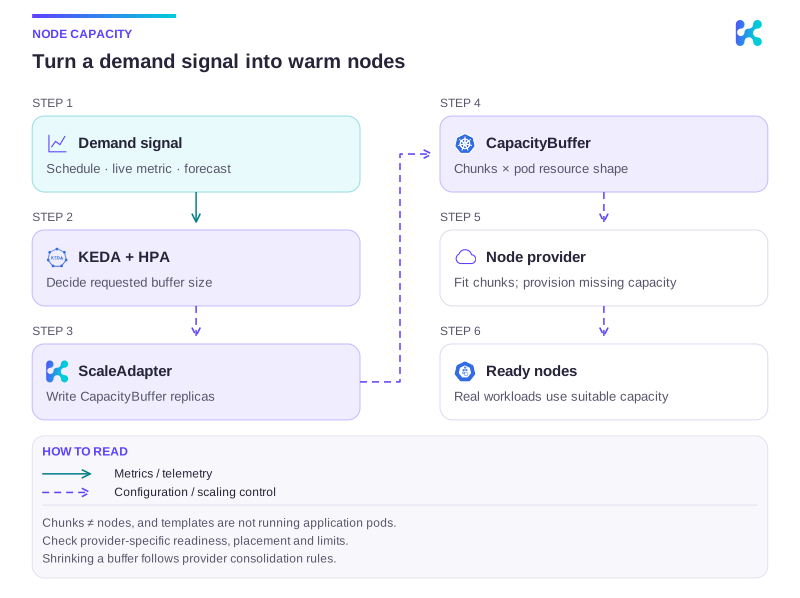
Diagram description
A KEDA ScaledObject drives a ScaleAdapter. The adapter writes CapacityBuffer replicas, representing chunks of a pod resource shape. The provider evaluates placement and provisions missing node capacity. Real application pods can then use suitable Ready nodes. Buffer chunks are capacity requests, not running application pods, and chunk count is not node count.
Custom target versus node buffer
Section titled “Custom target versus node buffer”ScaleAdapter exposes a custom resource through Kubernetes’ scale interface. For a CapacityBuffer, it changes the requested number of pod-shaped chunks, not the number of nodes. The provider decides how those chunks fit existing or new nodes. An adapter’s desired count does not prove that nodes or application pods are Ready.
Give the target field one writer. See ScaleAdapter API reference for other targets, including Agones Fleets.
Choose the provider path
Section titled “Choose the provider path”| Environment | Setup | Verify readiness | Constraints |
|---|---|---|---|
| Karpenter | Create and scale a buffer | Buffer conditions and NodeClaims | NodePool limits, placement and disruption settings. |
| Cluster Autoscaler | Create and scale a buffer | Buffer conditions and nodes | Supported controller versions, node-group limits and scheduling constraints. |
| GKE | Create and scale a buffer | Buffer conditions and nodes | Standby buffers exclude GPU/TPU nodes; active buffers have separate prerequisites. |
Validate ready capacity
Section titled “Validate ready capacity”Use the provider’s verification commands above. Confirm that Ready nodes have the resources, zones and taints/affinity required by the application; requested buffer chunks alone are insufficient. Measure provisioning plus application startup time to set schedule or forecast lead time.
When the buffer shrinks, node removal follows the provider’s consolidation rules and workload placement. Reducing the buffer does not guarantee immediate cost reduction. For desired replicas without ready pods, use workload diagnostics.